AI Adoption Is Identity Work
In 2024, Harvard, MIT, and Stanford researchers put 140 radiologists head-to-head with an AI model on chest X-ray diagnosis. They added a third condition: radiologists working with the AI.
AI alone outperformed about two-thirds of the radiologists. The expected story was the third condition winning. It didn't.
When radiologists worked with the AI, some got more accurate. But others got worse. The obvious predictors (e.g., years of experience, subspeciality, prior AI exposure, baseline accuracy) did not explain the split. None of them predicted who benefited. The pattern was real, and the cause was… something else.
A year earlier, Harvard Business School and BCG (Boston Consulting Group) ran a structurally similar experiment. 758 BCG consultants. GPT-4. 18 realistic consulting tasks. Three conditions: no AI, AI access, AI access with prompt training.
The researchers introduced a term worth keeping: the "jagged frontier." AI's capabilities are not a smooth curve where harder tasks are uniformly harder for the model. The frontier is jagged. Some tasks that look difficult are well within the AI's strength zone. Other tasks that look simple sit just outside it, where the model produces confident, plausible, wrong answers. The frontier is also invisible. Users cannot see where it is without testing.
For tasks inside the frontier, consultants with AI completed 12% more tasks, 25% faster, with output rated 40% higher quality. For tasks outside the frontier, AI-assisted consultants were 19 percentage points less likely to produce a correct answer than consultants working without AI. Same tool. Same training. Opposite outcomes, determined by whether the consultant could read the terrain.
The researchers also surfaced a behavioral split. One group of consultants treated AI as a delegated function with clear lanes (in other words, they treated AI like a junior colleague: handed it a defined task, took back the output, and did their own work alongside it). The other “joined” with the model continuously and stopped separating their work from the AI's work. Two very different mental models yield different results.
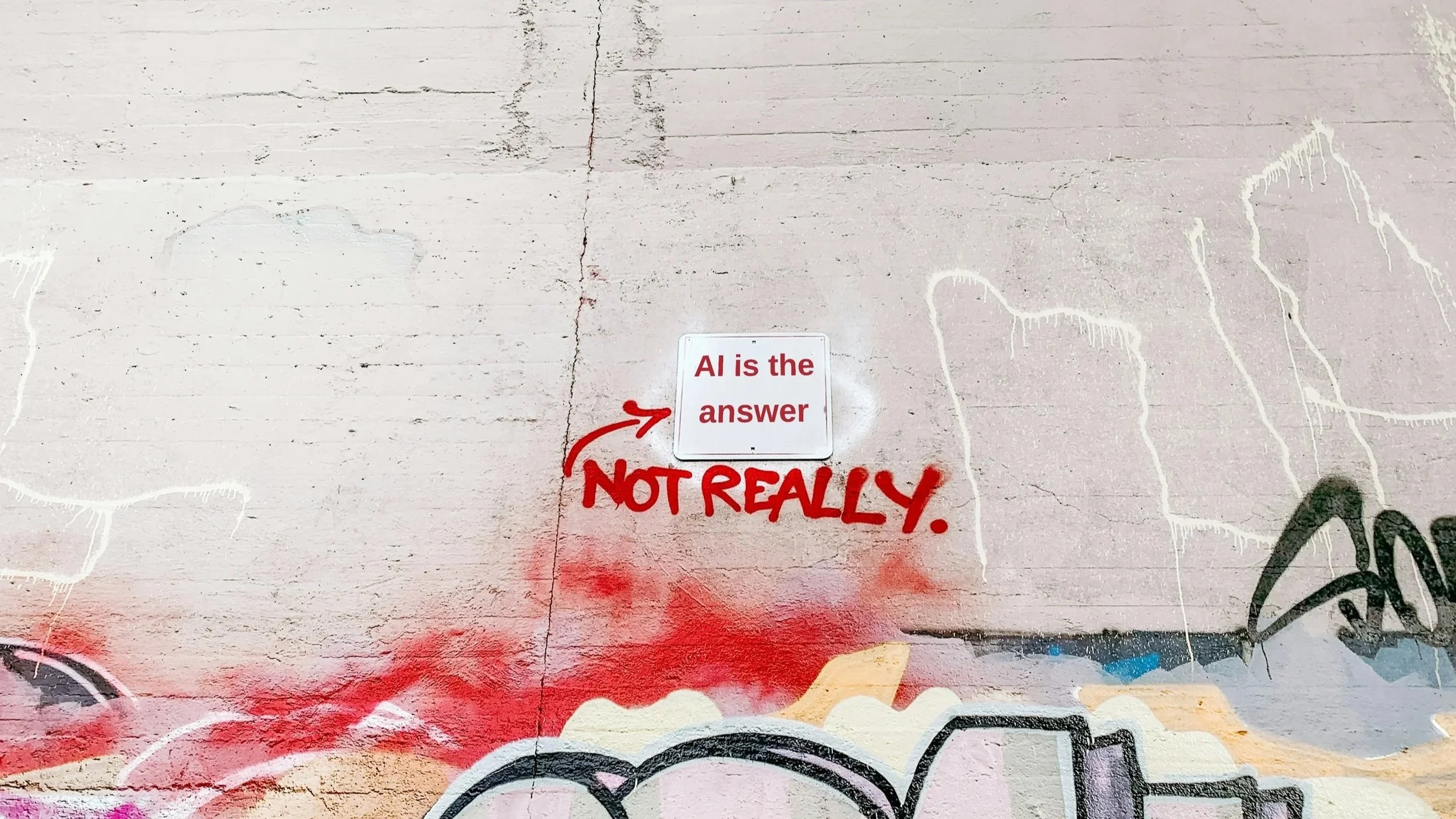
The sign is leadership's strategy. The graffiti is the workforce.
This is not a tooling problem
Most AI adoption programs assume that variance like this gets solved with more training, access, and use cases. That makes sense if the problem is unfamiliarity. People haven't used the tool long enough. Teach better prompts, run more enablement, show the team what good looks like and eventually, they'll get it.
But the split is driven by approach and mental model. By the feelings the user brings to the tool when it outperforms them. That answer is incomplete. You can teach prompts. You cannot teach someone how to hold their expertise in a room where a machine outperforms them on certain tasks. That is a different kind of work. It sits closer to identity than to tooling.
Good news: The behavioral science on this is very well developed (more than the change management literature has acknowledged), and that can give your AI change program an edge.
What the research actually shows
Three converging bodies of work explain the variance that the studies are documenting.
Threat appraisal
When employees encounter a new technology, they make a rapid judgment about whether it represents a challenge to grow into or a threat to defend against. The judgment is automatic and predicts most downstream behavior. Recent reviews of AI in the workplace find that defensive appraisals predict avoidant behaviors, while challenge appraisals predict approach behaviors like learning, experimentation, and proactive role redesign.
Self-determination theory
Forty years of research on workplace motivation converges on three psychological needs: autonomy, competence, and relatedness. When a change satisfies these needs, employees internalize it. When a change threatens them, employees resist or comply without commitment. Gagné and colleagues (2000) showed in a longitudinal study of a Canadian telecom going through major transformation that three specific manager behaviors substantially predicted change acceptance: providing a rationale, offering choice in execution, and acknowledging employees' feelings about the change.
Moral foundations
Jonathan Haidt's framework identifies several deep values that shape how people evaluate options: care, fairness, loyalty, authority, sanctity, and liberty/autonomy. I spent my master's thesis examining vaccine hesitancy (and health decisions more broadly) through this lens. The population that resisted vaccination was not unmoved by safety and efficacy data. They were processing the question through autonomy and sanctity concerns the public health campaigns never addressed. Reframing the message to engage those values, rather than override them, moved acceptance.
The same shape shows up with AI. Leadership talks about efficiency, productivity, and competitive advantage. But employees process the question through autonomy ("do I still get to decide how I work?") and dignity ("is my expertise still valued?"). The messages pass each other in the air. zoom
Five interventions with behavioral science behind them
Each of the following has a research base. Each addresses a specific mechanism that the studies above identified.
1. Moral reframing. Feinberg and Willer's research demonstrates that messages reframed in the audience's moral vocabulary, rather than the speaker's, produce substantially more attitude change. Most organizations frame AI adoption in efficiency and growth terms. That is the leadership team's moral vocabulary. Translate the same case into autonomy ("AI removes the parts of your job that don't use your judgment") and dignity ("we are investing in this because we value your expertise enough to give it more leverage"). Same goal, just different language. Materially different acceptance.
2. Autonomy-supportive communication. From Gagné et al. (2000): give a rationale, offer choice in execution, acknowledge feelings. In practice, this means leadership explaining why AI is being introduced in terms employees recognize as legitimate, leaving meaningful choice about how individual workflows incorporate it, and treating concerns as data rather than as resistance to manage around.
3. Job crafting. Wrzesniewski and Dutton's research on job crafting shows that employees who proactively redesign their tasks, relationships, and cognitive framing of their work demonstrate better adaptation to change. Recent research finds that AI introduction triggers either approach crafting (employees actively integrate AI into their evolving role) or avoidance crafting (employees redesign work to minimize AI exposure). Organizations can structurally encourage approach crafting by creating explicit time, language, and reward for AI-integrated role redesign rather than treating role descriptions as fixed.
4. Self-affirmation. Decades of work by Cohen, Sherman, and others show that brief reflective exercises about personal values reduce threat responses and improve performance under identity threat. Lin and colleagues (2025) recently applied this directly to AI introduction and found that self-affirmation exercises increased employees' willingness to engage with AI through approach crafting. The intervention is cheap. A 15-minute structured reflection on what makes an employee valuable to the organization, conducted before AI tools are introduced, measurably changes the response.
5. Procedural justice. Tyler and Lind's work on organizational justice shows that perceived fairness of the process predicts acceptance of the outcome, often more than the outcome itself does. For AI adoption, this means involving the people who will use the tool in selecting it, designing the rollout, and naming what good integration looks like. Voice in the process produces ownership of the result.
What this means for change management
The teams that win the AI adoption race in the next five years will not be the ones with the largest enablement budgets or the slickest training. They will be the ones whose change management programs treated AI adoption as identity work and built skill work on top of that foundation.
The research is already telling us this. The radiologists and consultants are sitting in front of identical tools with identical training and producing wildly different outcomes. The variable that moves is the meaning the professional is making of the tool.
Organizations can address that. The behavioral science exists. Most change management programs simply haven't caught up to it yet.
That gap is the opportunity.
***
Sources (in order of reference)
- Yu, F., Moehring, A., Banerjee, O., Salz, T., Agarwal, N., & Rajpurkar, P. (2024). Heterogeneity and predictors of the effects of AI assistance on radiologists. Nature Medicine, 30(3), 837-849.
- Dell'Acqua, F., McFowland III, E., Mollick, E. R., Lifshitz-Assaf, H., Kellogg, K., Rajendran, S., Krayer, L., Candelon, F., & Lakhani, K. R. (2023). Navigating the Jagged Technological Frontier. HBS Working Paper No. 24-013.
- Gagné, M., Koestner, R., & Zuckerman, M. (2000). Facilitating acceptance of organizational change: The importance of self-determination. Journal of Applied Social Psychology, 30(9), 1843-1852.
- Feinberg, M., & Willer, R. (2019). Moral reframing: A technique for effective and persuasive communication across political divides. Social and Personality Psychology Compass, 13(12), e12501.
- Wrzesniewski, A., & Dutton, J. E. (2001). Crafting a job: Revisioning employees as active crafters of their work. Academy of Management Review, 26(2), 179-201.
- Cohen, G. L., & Sherman, D. K. (2014). The psychology of change: Self-affirmation and social psychological intervention. Annual Review of Psychology, 65, 333-371.
- Tyler, T. R., & Lind, E. A. (1992). A relational model of authority in groups. Advances in Experimental Social Psychology, 25, 115-191.