The Loss of Control Goes All the Way Up
On Friday, June 12, 2026, at 5:21 PM Eastern Time, Anthropic received a letter from the US Commerce Department. By 9:59 PM, the company's two most advanced AI models, Fable 5 and Mythos 5, were no longer available to any customer anywhere in the world.
The reason given was national security. The letter did not specify the concern. Anthropic later disclosed its understanding of the trigger: a narrow jailbreak technique that the company's own analysis indicated is also present in other publicly available models, including OpenAI's GPT-5.5. Anthropic complied with the directive while publicly disagreeing with the standard it set.
In other words, a frontier AI model was released, restricted under national security authority, and switched off for everyone in the same news cycle. Customers who had built products on top of it had hours, not weeks, to scramble for alternatives. The company's own CEO did not know on Friday morning that the model would be gone by Friday night.
The natural reaction in a change management deck is to file this under "regulatory complexity" or "tail risk." That misses the more important reading. Your workforce saw this. They are reading what it implies. And the conclusion they're reaching is more defensible than most adoption playbooks are willing to admit.

What the workforce actually sees
For two years, employees have been told a version of the same story by their leaders. AI is the future of our company. We are investing in this tool. We expect you to adopt it. Your role and your future depend on integrating it into your daily work.
Then, in three hours, the most advanced model from the most safety-focused major AI company in the world disappeared. The company building it could not prevent the disappearance. The customers, depending on it had no recourse. Nobody could promise it would come back, or what would replace it, or which tool would be next.
If you have spent any time in mandatory training on a vendor product that quietly got deprecated six months later, you already know how to read this signal. The signal is that betting your professional identity on a specific tool, in a domain where the tool itself can vanish overnight by government order, is a worse bet than your leadership is admitting.
The leaders don't actually know either (yikes)
Here is the part most adoption playbooks studiously avoid. The people demanding the commitment are no more certain than the people resisting it.
Dataiku and Harris Poll surveyed CEOs globally in May 2026 and found that 80% believe their own job is at risk by the end of 2026 if their AI strategies fail. In the US, the figure is 81%. BCG's January 2026 AI Radar survey of 640 CEOs and 2,360 senior leaders found that half of the CEOs said their job stability depends on getting AI right this year. PwC's 29th Global CEO Survey, released at Davos, found CEO confidence in their own company's revenue prospects at a five-year low, with only 12% reporting AI has delivered both cost and revenue benefits. 56% said they are getting nothing from AI yet.
Combine those findings, and a clearer picture emerges. The leadership pushing AI adoption is doing so under personal job risk, with thin returns to date, in a market where the most advanced tools can be revoked by the government without notice. They are uncertain in ways they cannot say out loud.
Vilas Dhar, president of the Patrick J. McGovern Foundation, wrote about this directly the night of the Fable 5 shutdown. The decisions affecting which AI exists, who can access it, and on what terms are being made for everyone, in hours, with no public process. That observation is correct, and it applies inside the company as much as outside it.
The asymmetry employees correctly sense
When a leader tells a worker to commit to a tool, the implicit contract is straightforward: I am asking you to invest in this, and in exchange, the tool will be there, the company will support you, and the skill you build will pay off.
What this week made vivid is that the leader cannot honor any of those terms unilaterally. The tool can vanish. The company's AI vendor can be restricted overnight. The skill the worker builds may be specific to a model that no longer exists in six months.
Workers who hesitate to bet their professional identity on this contract are pricing in the same uncertainty that the CEO surveys are pricing in privately. The difference is that the CEO is told to project confidence, and the employee is told to comply.
Sixty years of psychological research on reactance (Brehm, 1966) and on procedural justice (Tyler and Lind) predict how workers respond to that combination. When the cost of compliance is real, and the legitimacy of the demand is questionable, people protect their autonomy by foot-dragging, by hedging, by quiet refusal. The labels "resistance," "ignorance," and "Luddism" are how organizations name behavior whose actual driver is rational risk pricing they refuse to recognize.
What this changes for leaders
The first move is to stop pretending. The leadership communication style most companies still use, projecting certainty about the AI roadmap, treating doubt as a problem to manage, and framing non-adoption as a personal failing, is generating reactance that compounds with each headline like this week's. Workers know what they're reading. The dissonance between what they see and what they're told is the actual source of their resistance.
The honest alternative is harder and more durable. Acknowledge the uncertainty. Tell the workforce what you are confident in, what you are guessing about, and what you do not know. The companies that have done this with other transformations (the move to cloud, the early years of remote work) have consistently outperformed those that played certainty theater.
The second move is to design adoption for a world where the tools will change. Build skill in working with AI rather than skill in any specific model. Protect the worker's underlying capability (judgment, relationships, ability to read the work) from being entirely outsourced to a vendor who may not exist or may not be available next year. The cognitive offloading argument I made in earlier pieces lands harder when the news cycle keeps reminding everyone how thin the ground is.
The third move is to listen to the resistance for the signal in it. The workers who hesitate are often the ones reading the situation most accurately. Treating their hesitance as information rather than as a problem to overcome is the change management posture this moment actually calls for.
The deeper point
What this week showed is that the loss-of-control feeling running through the workforce around AI is an accurate reading of a system in which:
The companies building AI cannot fully predict what their models can do.
The governments regulating AI act in hours with a limited public process.
The CEOs deploying AI face personal job risk if it fails. The workers being asked to commit have the least information and the least leverage of anyone in the chain.
Every party in this chain is uncertain. Only the worker is told to project confidence to the people below them, or, more often, told to comply quietly.
Most AI adoption frameworks circulating right now assume the worker is the irrational party. The week's events suggest the worker may be the one party in this system reading the conditions accurately. The vaccine research I did years ago kept finding the same pattern. When an institution cannot acknowledge the legitimacy of what the resister is sensing, the resistance hardens, and the campaign fails on the institution's own terms.
The leaders who handle this well in the next few years will be the ones who learn to lead through honest uncertainty rather than perform certainty. The rest will keep generating exactly the resistance they are trying to overcome.
***
Sources
Anthropic (2026). Statement on the US government directive to suspend access to Fable 5 and Mythos 5. June 12, 2026. https://www.anthropic.com/news/fable-mythos-access
CNBC (2026). Anthropic disables access to Fable 5 and Mythos 5 to comply with government directive. June 12, 2026.
Bloomberg (2026). Anthropic Says US Orders Halt to Foreign Access for Fable 5, Mythos 5 AI Models. June 13, 2026.
Dataiku & Harris Poll (2026). Global CEO AI risk survey. May 2026.
Boston Consulting Group (2026). AI Radar 2026. January 2026. 640 CEOs and 2,360 senior leaders surveyed.
PwC (2026). 29th Global CEO Survey: Leading Through Uncertainty in the Age of AI. January 2026.
Brehm, J. W. (1966). A Theory of Psychological Reactance. Academic Press.
Tyler, T. R., & Lind, E. A. (1992). A relational model of authority in groups. Advances in Experimental Social Psychology, 25, 115–191.
What If AI Is Erasing the Way You Got Good at Your Job?
In August 2025, Anthropic studied 132 of its own engineers and researchers. Fifty-three sat for detailed interviews. The team analyzed how they actually used Claude Code at work. The headline findings were the ones you'd expect from an AI company. People felt more productive, more "full stack," able to take on projects that wouldn't have happened otherwise. Twenty-seven percent of AI-assisted work was net-new, things that wouldn't have been built at all without the tool.
The quieter findings are the ones worth paying attention to.
The heavy users reported worry about their own skills atrophying. One described shifting to roughly 70% reviewer of AI-generated code rather than someone who builds. Several said Claude had become the first stop for questions that used to go to colleagues. One said, in plain words, that they liked working with people, and it was sad they needed them less now.
These are the most AI-fluent engineers on the planet, at the company building the tool. And they're describing the early shape of something organizations are not yet measuring: the slow erosion of how professionals build, sharpen, and pass on the thing that made them good in the first place.

What skill atrophy actually means
The phrase suggests losing existing skills. That happens, but it's only part of the story. The deeper problem is the loss of the conditions that produce skill.
Professionals don't develop judgment in classrooms. They develop it through reps: drafting the bad version, debugging the broken system, sitting with the messy customer call, asking the colleague who's seen this one before. The struggle itself is the curriculum. Each rep produces a small, durable update in how someone reads their work. Strip out the struggle and the update doesn't happen.
This is well-documented outside AI. Three decades of research on expertise (Ericsson and colleagues) consistently finds that what builds judgment is deliberate practice under appropriate difficulty, with feedback from someone who's already done the work. Master-apprentice studies in surgery, law, and trades describe the same pattern. You try things slightly beyond your reach, fail in front of someone who can show you what you missed, and try again with that feedback in your head.
What AI offloading does is quietly remove the friction those reps depend on. The first draft you would have struggled through is generated cleanly in seconds. The debugging session you would have learned from is collapsed into a fix you accept and move on. The question you would have brought to a senior colleague is answered by the tool before you finish framing it. Each handoff feels like a win in the moment. Cumulatively, they remove the difficulty that builds the worker.
The mentorship side is doing damage you can't see yet
The Anthropic engineers, naming a drop in colleague interaction, are reporting the part of the loss that's hardest to measure and easiest to dismiss.
Mentorship has never been a clean, formal channel. Most of it happens in the small moments. The junior person walks over with a half-formed question. The senior person looks up, asks what they've tried, points at the part they missed, and sometimes opens a tangent that turns out to be the real lesson. The junior person learns that the question itself was wrong, which is the actual skill. The senior person sharpens their own thinking by being asked.
That exchange has costs. The senior person's time is the obvious one. The implicit social cost (asking for help, admitting confusion, owing something to a colleague) is the bigger one. AI removes both. There's no time tax, no social tax, and the answer arrives in a form polished enough to feel definitive.
The junior worker loses three things at once. They lose the answer-shaped-as-conversation that taught them how senior people think. They lose the calibration that comes from a real person assessing how lost they are. And they lose the relationship that would have made the senior person an advocate later. None of these show up on a dashboard. All of them are how careers actually get built.
The senior worker loses something too: the cognitive sharpening that comes from explaining your judgment to someone who doesn't yet have it. Teaching is how experts maintain their own expertise. Remove the requests for help, and the senior worker's judgment also starts to drift.
This is a layer of an older trend
Knowledge workers are encountering a new version of a pattern that other workers have been living with for over a decade.
Since at least 2015, researchers (Lee and colleagues; Kellogg, Valentine, and Christin in their 2020 Academy of Management Annals synthesis) have documented how software increasingly performs the work managers used to do: assigning tasks, scoring performance, flagging who's behind. They call it algorithmic management. The findings are consistent across studies. Worker autonomy declines. Mentorship and feedback erode because the supervisory layer that produced them is gone. A January 2026 monitoring study found nearly half of surveilled workers would consider quitting if monitoring increased further. The frontline has been telling us what this feels like for years.
What's specifically new about AI is the location. Earlier tools worked from the outside. They measured your work. AI sits inside the work. It does some of the work with you, and quietly does some of the thinking that used to live in the job. The same erosion of skill, mentorship, and autonomy that the frontline reported a decade ago is now arriving at the knowledge worker's desk through a different door.
Why this hurts more than the productivity gain helps
Self-determination theory (Deci and Ryan, the most empirically supported framework in workplace motivation) identifies three psychological needs that predict engagement and well-being at work: autonomy, competence, and relatedness. Autonomy is the sense that your work is yours to direct. Competence is the felt experience of getting better at something that matters. Relatedness is the sense that the people you work with see and value your contribution.
Cognitive offloading at scale, without redesigning the work around it, threatens all three.
Autonomy gets undercut by adoption mandates and by the felt sense that the tool is shaping what gets done. Competence gets undercut by the loss of the reps and feedback loops that produced it. Relatedness gets undercut by the disappearance of the small mentorship moments that built professional relationships. The Anthropic engineers naming each of these in the same study is not a coincidence. It's what the theory predicts
The productivity gain is real. It also doesn't replace what's being lost, because the things being lost are not in the same currency as output. They're the conditions that make output durable and the worker capable of producing it again next year. An organization optimizing for this quarter's productivity while eroding next year's capability is doing something it would never let happen on the balance sheet. It's doing it on the workforce because the depreciation is invisible.
What this asks of leaders
The work is treating capability-building infrastructure as something that has to be designed in, because the old version is being designed out by default.
Preserve the reps that build judgment. Some work needs to stay slow. Identify which work is capability-building (early career, novel problem, judgment-heavy) and protect it from blanket adoption mandates. A junior analyst who never writes a flawed first draft will not develop the eye that catches one.
Pay for the mentorship that AI quietly displaces. Time spent helping a junior colleague is a higher-cost activity in a system that didn't price it before. If you want it to keep happening, make it count on the senior person's evaluation, rather than relying on their goodwill. The companies that built this kind of incentive into diversity and inclusion programs already know how.
Slow the metrics down. Tracking AI usage and self-reported time saved tells you the tool is being used. It tells you nothing about whether the worker is still becoming a better version of themselves. Layer in measures that catch the slower variable: judgment quality over time, skill development at junior levels, and the rate at which senior people are still being consulted by their teams.
Redesign roles around what humans do that AI cannot, and protect those parts. Workday's 2026 research found 89% of organizations have updated fewer than half of their roles to reflect what AI has changed about the work. That gap is where the erosion does its work uninterrupted. Closing it is the actual change management task.
The honest framing
The Anthropic engineers I quoted at the start of this piece are doing something organizations should learn from. They're naming a loss while still using the tool that produces it. They continue working with AI, and they want their employer to see what it's costing them.
The vaccine research I did years ago kept finding the same thing: when an institution cannot see what its ask means to the person being asked, the campaign fails in the same ways every time. The AI version of that mistake is happening in slow motion, but it's the same mistake. Adoption gets measured. The cost of adoption doesn't show up until it shows up somewhere the organization can no longer recover from. By the time you can see skill atrophy on a performance review, the pipeline that would have produced your next senior person is already several years thinner than you realized.
The leaders who get AI right over the next few years will be the ones who treat the rollout as a question about human capability and design the answer in, rather than letting the answer happen to them.
***
Sources:
Anthropic (2025). How Anthropic Teams Use Claude Code. Internal study, August 2025. 132 engineers/researchers surveyed, 53 interviews. https://www.anthropic.com/news/how-anthropic-teams-use-claude-code
Lee, M. K., Kusbit, D., Metsky, E., & Dabbish, L. (2015). Working with machines: The impact of algorithmic and data-driven management on human workers. CHI Conference on Human Factors in Computing Systems.
Kellogg, K. C., Valentine, M. A., & Christin, A. (2020). Algorithms at work: The new contested terrain of control. Academy of Management Annals, 14(1), 366–410.
Ericsson, K. A., Krampe, R. T., & Tesch-Römer, C. (1993). The role of deliberate practice in the acquisition of expert performance. Psychological Review, 100(3), 363–406. (And subsequent body of work through Ericsson's later career.)
Deci, E. L., & Ryan, R. M. (2000). The "what" and "why" of goal pursuits: Human needs and the self-determination of behavior. Psychological Inquiry, 11(4), 227–268.
Workday (2026). Beyond Productivity: Measuring the Real Value of AI. January 2026. https://newsroom.workday.com/2026-01-14-New-Workday-Research-Companies-Are-Leaving-AI-Gains-on-the-Table
AI adoption Has Two Failure Modes, and They Share a Root Cause.
My last article argued that AI adoption fails because organizations treat it as a tooling problem when it is closer to identity work. People resist not because they can't learn the tool, but because the tool threatens their autonomy and their sense of being valued for their judgment.
That covered one way adoption fails. Resistance. Refusal. Shadow AI. Sabotage.
There is a second way, and it is the opposite of resistance. It happens inside teams that adopted enthusiastically, hit their usage targets, and look like success stories on the dashboard. The research is only months old, which is part of why most companies can't see it yet.
Both failure modes come from the same place. To explain how, I need to start with a concept that predates AI by decades.

Adoption is cognitive offloading
Cognitive offloading is the use of external tools to carry out mental work the brain would otherwise do. Writing a phone number down instead of memorizing it is cognitive offloading. So is using a calculator, a calendar, or a grocery list. We have been doing it for as long as we have had tools.
AI offloading is different in three specific ways.
A calculator offloads arithmetic. A calendar offloads memory of dates. Each tool offloads one narrow function, and you stay in charge of everything around it. AI offers to offload across every domain at once: writing, analysis, judgment, and decision-making. There is no natural boundary on what you can hand over.
AI output looks finished. A calculator returns a number you still have to interpret. AI returns a polished paragraph, a confident recommendation, a complete answer. The polish signals "done," which lowers the felt need to check.
And AI is confidently wrong at unpredictable moments. A calculator that says 7 is right. An AI that says the contract clause is enforceable might be right, or might be inventing case law, and it delivers both with identical confidence. The signal that usually tells you to slow down and verify is absent.
When an organization pushes adoption, it is pushing cognitive offloading at scale, into a workforce and a set of workflows that were not redesigned to manage it. That is the root cause. Everything below is a downstream effect.
Three responses to offloading
People respond to large-scale cognitive offloading in three ways. The first is the subject of my last article. The other two are the subject of this one.
Response one: rejection
Some workers refuse to offload. They experience the demand to hand cognitive work to AI as a threat to their autonomy, their expertise, or their professional identity, and they push back. This is the resistance failure mode: the sabotage, the shadow AI, the quiet non-adoption documented in the Writer/Workplace Intelligence 2026 survey, where 29% of employees admitted to actively working against their company's AI strategy.
Reactance theory (Brehm, 1966) predicted this sixty years ago. Restrict someone's autonomy and they act to restore it. Most AI rollouts restrict autonomy by mandate, then are surprised by the reaction.
Response two: strained acceptance
Some workers accept the offloading but keep trying to oversee it, and the oversight load breaks them.
In a March 2026 BCG Henderson Institute study of 1,488 US workers (published in Harvard Business Review), 14% of AI users reported what the researchers named "brain fry": mental fatigue from oversight of AI tools beyond their cognitive capacity. Those workers showed 33% more decision fatigue and 39% more major errors than colleagues without it. 34% intended to quit.
The BCG team found a threshold effect. Productivity rose with up to three AI tools and fell off once workers were managing four or more. Each additional tool is another output to verify, another interface to track, another source of plausible-looking error to catch. The worker is still doing the cognitive work. They are doing more of it than before, because now they are thinking and supervising a machine that thinks differently than they do.
Brain fry is what offloading does to a worker who refuses to fully let go. They hold onto their judgment and pay for it in exhaustion.
Response three: disengaged acceptance
Some workers accept the offloading and stop overseeing it. This is the failure mode with the newest name and the sharpest edge.
Wharton researchers Steven Shaw and Gideon Nave (January 2026) call it cognitive surrender: adopting AI outputs with minimal scrutiny, overriding both intuition and deliberation. Across three preregistered experiments with 1,372 participants and 9,593 trials, they manipulated whether an AI assistant gave correct or incorrect answers. Participants consulted the AI on most trials. When it was accurate, their accuracy rose 25 points. When it was faulty, their accuracy fell 15 points.
People adopted wrong answers because the AI supplied them. Not because they were tired. Because they had stopped checking.
Shaw and Nave frame this with what they call Tri-System Theory. Classic psychology describes two modes of thinking: System 1, fast and intuitive, and System 2, slow and deliberate. They propose a System 3: artificial cognition that sits outside the brain and can either supplement the other two or replace them. Cognitive surrender is System 3 supplanting System 2. The deliberation step doesn't happen because the machine appears to have already done it.
Their data points to who is most exposed. Participants with higher trust in AI and lower need for cognition surrendered more readily. The people most likely to stop thinking are the ones already inclined to find thinking effortful and to trust the machine that offers to do it for them.
Brain fry and cognitive surrender are not the same problem
This distinction matters because the two look identical on the surface and require opposite fixes.
Both produce uncritical acceptance of AI output. Both degrade quality. But brain fry is an overloaded oversight, and cognitive surrender is an abandoned oversight. One worker is drowning while trying to swim. The other has stopped swimming.
The mechanisms differ. Brain fry is a capacity problem: the worker wants to oversee and cannot keep up. Cognitive surrender is an engagement problem: the worker is not trying to oversee at all.
The antecedents differ. Brain fry comes from too many tools and too much oversight load. Cognitive surrender comes from high trust in AI and low need for cognition.
The observable signs differ. The brain-fried worker shows rework, errors, exhaustion, and intent to quit. The surrendered worker shows the opposite surface signs: fast turnaround, few corrections, apparent confidence, and a quiet collapse in decision quality that only shows up when the AI is wrong, and no one catches it.
Treat them the same, and you will prescribe the wrong fix for half your people. Give a brain-fried worker an engagement protocol, and you add load to someone already overloaded. Give a surrendered worker workload relief, and you remove the last friction that might have made them think.
Why do companies build a system that produces all three?
This is the part that should bother any leader running an AI program right now. The standard adoption playbook generates all three failure modes at once.
Adoption is mandated without redesigning roles. Workday's January 2026 research found that 89% of organizations have updated fewer than half of their roles to reflect what AI has changed about the work. The tool arrived. The job description, the workflow, and the cognitive demands did not move with it.
Success is measured by usage, not by judgment quality. Dashboards count logins, prompts, and self-reported time saved. The same Workday study found that while 85% of employees report saving time with AI, only 14% achieve a consistently net-positive outcome after accounting for rework. Usage metrics see adoption working. They are blind to whether the work got better.
Failure is diagnosed as a skills gap. The widely cited MIT report on stalled enterprise AI framed the problem as a "learning gap" and pointed toward better tools and more training. Training addresses the rejection failure mode. It does nothing for brain fry, which is a load problem, or for cognitive surrender, which is an engagement problem. A worker who has surrendered their judgment does not need another prompt-engineering course.
So companies push adoption, reward usage, punish non-use, and train for skills. That approach manages exactly one of the three responses and actively worsens the other two. Mandates increase reactance. Usage rewards encourage the heavy tool stacking that produces brain fry. And nothing in the playbook even accounts for cognitive surrender, because the surrendered worker hits every adoption metric the company tracks.
Interventions, by failure mode
The fix is not less AI. It is designing the human system around the offloading instead of pretending the offloading is free.
For rejection, the interventions are the ones from my last article: autonomy-supportive communication, moral reframing in the employee's value vocabulary, procedural justice in how the rollout is decided, and self-affirmation before the tool is introduced. The goal is to lower the threat so the worker does not have to defend their autonomy by refusing.
For brain fry, the interventions reduce oversight load. Consolidate the tool stack, because the BCG threshold suggests three tools is roughly where useful turns harmful. Redesign workflows so a human is not the verification layer for every AI output. Reserve human oversight for the decisions where it changes the outcome, and let go of the ones where it does not. The BCG team found that using AI to remove routine work actually lowered burnout; the damage came specifically from oversight-heavy use. The target is the oversight, not the AI.
For cognitive surrender, the interventions force re-engagement. Build deliberate friction back into high-stakes decisions: a required step where the human states their own answer before seeing the AI's, so System 2 fires before System 3 can replace it. Design roles around judgment that the worker owns and is accountable for, rather than outputs they merely pass along. Watch for the workers Shaw and Nave flagged, the high-trust low-effort profile, and structure their work so disengagement is harder. Restoring some uncertainty to the AI's outputs, rather than presenting them as finished, helps too. The polish is part of what triggers the surrender.
Notice that the brain fry and cognitive surrender interventions point in opposite directions. One removes friction. One adds it. That is the whole reason the distinction matters.
The underlying move
Stop treating AI rollouts as software deployments. A software deployment asks whether people are using the tool. A cognitive architecture redesign asks what happens to human judgment when the tool is in the loop, and builds the roles, workflows, and incentives around that answer.
The companies struggling with AI are not struggling because they bought the wrong models or wrote the wrong prompts. They are struggling because they changed how cognition flows through the organization and never redesigned the organization around the change. They offloaded thinking at scale and assumed the thinking would take care of itself.
It will not. Some people refuse the offload. Some drown in overseeing it. Some disappear into it. The technology works fine. The human system underneath it is failing in three directions at once, and a better model fixes none of them.
What strikes me, reading this research next to my own work on why people resist vaccines, is how familiar the shape is. We keep building campaigns and rollouts around the thing we want people to do, and we keep getting blindsided by what the ask means to them. The leaders who get AI right over the next few years will not be the ones who bought the most licenses. They will be the ones who treated the rollout as a question about human judgment and designed for the answer.
***
Sources (in order as they appear)
Shaw, S. D., & Nave, G. (2026). Thinking—Fast, Slow, and Artificial: How AI is Reshaping Human Reasoning and the Rise of Cognitive Surrender. SSRN/OSF preprint, January 2026. https://ssrn.com/abstract=6097646
Bedard, J., Kropp, M., Hsu, M., Karaman, O., Hawes, J., & Kellerman, G. (2026). When Using AI Leads to "Brain Fry." Harvard Business Review / BCG Henderson Institute, March 2026. https://www.bcg.com/news/5march2026-when-using-ai-leads-brain-fry
Workday (2026). Beyond Productivity: Measuring the Real Value of AI. January 2026. https://newsroom.workday.com/2026-01-14-New-Workday-Research-Companies-Are-Leaving-AI-Gains-on-the-Table
Hancock, J., et al. (2025). AI-Generated "Workslop" Is Destroying Productivity. Harvard Business Review, September 2025. https://hbr.org/2025/09/ai-generated-workslop-is-destroying-productivity
Writer / Workplace Intelligence (2026). Enterprise AI adoption survey.
Brehm, J. W. (1966). A Theory of Psychological Reactance. Academic Press.
AI Adoption Is Identity Work
In 2024, Harvard, MIT, and Stanford researchers put 140 radiologists head-to-head with an AI model on chest X-ray diagnosis. They added a third condition: radiologists working with the AI.
AI alone outperformed about two-thirds of the radiologists. The expected story was the third condition winning. It didn't.
When radiologists worked with the AI, some got more accurate. But others got worse. The obvious predictors (e.g., years of experience, subspeciality, prior AI exposure, baseline accuracy) did not explain the split. None of them predicted who benefited. The pattern was real, and the cause was… something else.
A year earlier, Harvard Business School and BCG (Boston Consulting Group) ran a structurally similar experiment. 758 BCG consultants. GPT-4. 18 realistic consulting tasks. Three conditions: no AI, AI access, AI access with prompt training.
The researchers introduced a term worth keeping: the "jagged frontier." AI's capabilities are not a smooth curve where harder tasks are uniformly harder for the model. The frontier is jagged. Some tasks that look difficult are well within the AI's strength zone. Other tasks that look simple sit just outside it, where the model produces confident, plausible, wrong answers. The frontier is also invisible. Users cannot see where it is without testing.
For tasks inside the frontier, consultants with AI completed 12% more tasks, 25% faster, with output rated 40% higher quality. For tasks outside the frontier, AI-assisted consultants were 19 percentage points less likely to produce a correct answer than consultants working without AI. Same tool. Same training. Opposite outcomes, determined by whether the consultant could read the terrain.
The researchers also surfaced a behavioral split. One group of consultants treated AI as a delegated function with clear lanes (in other words, they treated AI like a junior colleague: handed it a defined task, took back the output, and did their own work alongside it). The other “joined” with the model continuously and stopped separating their work from the AI's work. Two very different mental models yield different results.
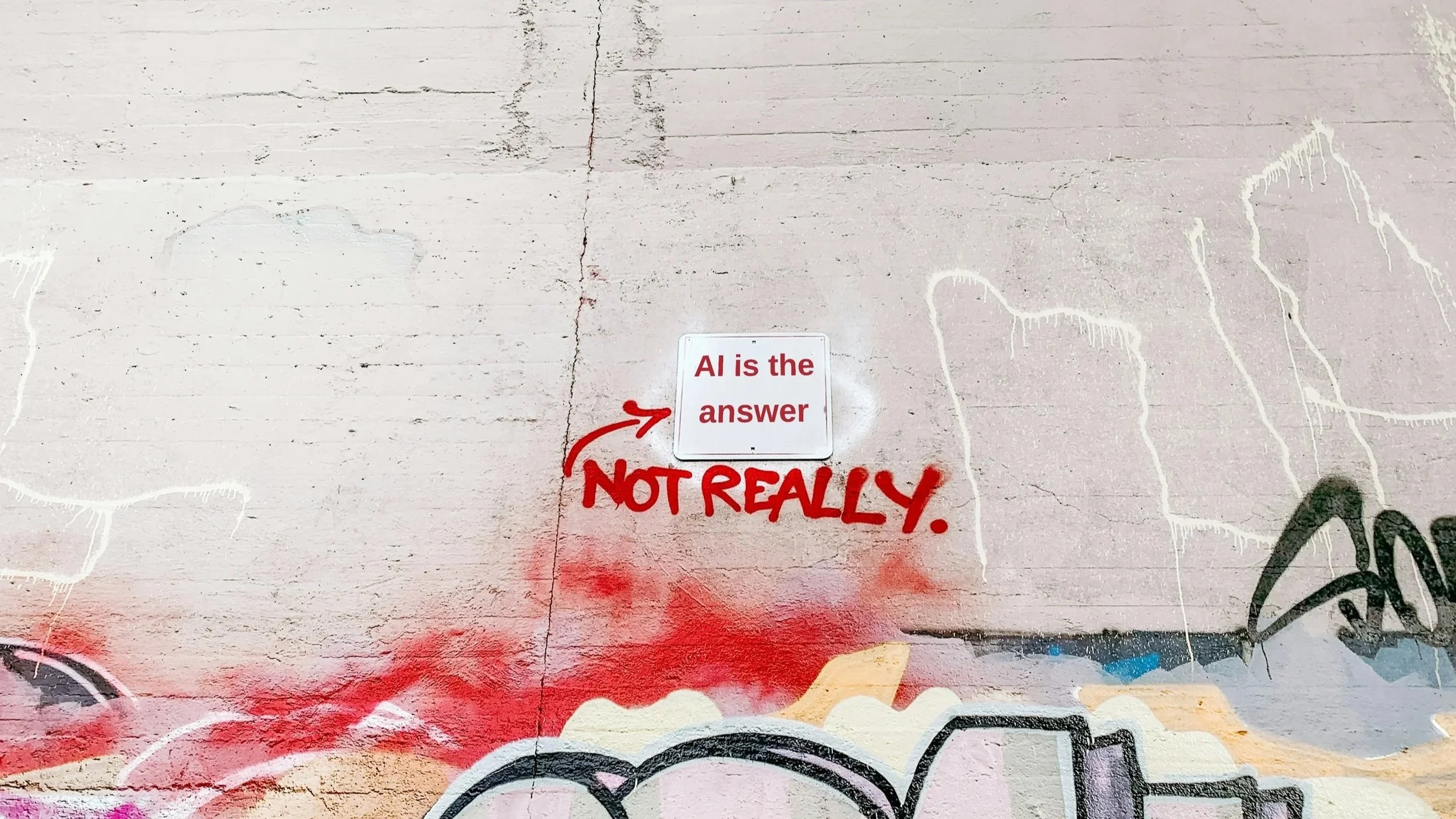
The sign is leadership's strategy. The graffiti is the workforce.
This is not a tooling problem
Most AI adoption programs assume that variance like this gets solved with more training, access, and use cases. That makes sense if the problem is unfamiliarity. People haven't used the tool long enough. Teach better prompts, run more enablement, show the team what good looks like and eventually, they'll get it.
But the split is driven by approach and mental model. By the feelings the user brings to the tool when it outperforms them. That answer is incomplete. You can teach prompts. You cannot teach someone how to hold their expertise in a room where a machine outperforms them on certain tasks. That is a different kind of work. It sits closer to identity than to tooling.
Good news: The behavioral science on this is very well developed (more than the change management literature has acknowledged), and that can give your AI change program an edge.
What the research actually shows
Three converging bodies of work explain the variance that the studies are documenting.
Threat appraisal
When employees encounter a new technology, they make a rapid judgment about whether it represents a challenge to grow into or a threat to defend against. The judgment is automatic and predicts most downstream behavior. Recent reviews of AI in the workplace find that defensive appraisals predict avoidant behaviors, while challenge appraisals predict approach behaviors like learning, experimentation, and proactive role redesign.
Self-determination theory
Forty years of research on workplace motivation converges on three psychological needs: autonomy, competence, and relatedness. When a change satisfies these needs, employees internalize it. When a change threatens them, employees resist or comply without commitment. Gagné and colleagues (2000) showed in a longitudinal study of a Canadian telecom going through major transformation that three specific manager behaviors substantially predicted change acceptance: providing a rationale, offering choice in execution, and acknowledging employees' feelings about the change.
Moral foundations
Jonathan Haidt's framework identifies several deep values that shape how people evaluate options: care, fairness, loyalty, authority, sanctity, and liberty/autonomy. I spent my master's thesis examining vaccine hesitancy (and health decisions more broadly) through this lens. The population that resisted vaccination was not unmoved by safety and efficacy data. They were processing the question through autonomy and sanctity concerns the public health campaigns never addressed. Reframing the message to engage those values, rather than override them, moved acceptance.
The same shape shows up with AI. Leadership talks about efficiency, productivity, and competitive advantage. But employees process the question through autonomy ("do I still get to decide how I work?") and dignity ("is my expertise still valued?"). The messages pass each other in the air. zoom
Five interventions with behavioral science behind them
Each of the following has a research base. Each addresses a specific mechanism that the studies above identified.
1. Moral reframing. Feinberg and Willer's research demonstrates that messages reframed in the audience's moral vocabulary, rather than the speaker's, produce substantially more attitude change. Most organizations frame AI adoption in efficiency and growth terms. That is the leadership team's moral vocabulary. Translate the same case into autonomy ("AI removes the parts of your job that don't use your judgment") and dignity ("we are investing in this because we value your expertise enough to give it more leverage"). Same goal, just different language. Materially different acceptance.
2. Autonomy-supportive communication. From Gagné et al. (2000): give a rationale, offer choice in execution, acknowledge feelings. In practice, this means leadership explaining why AI is being introduced in terms employees recognize as legitimate, leaving meaningful choice about how individual workflows incorporate it, and treating concerns as data rather than as resistance to manage around.
3. Job crafting. Wrzesniewski and Dutton's research on job crafting shows that employees who proactively redesign their tasks, relationships, and cognitive framing of their work demonstrate better adaptation to change. Recent research finds that AI introduction triggers either approach crafting (employees actively integrate AI into their evolving role) or avoidance crafting (employees redesign work to minimize AI exposure). Organizations can structurally encourage approach crafting by creating explicit time, language, and reward for AI-integrated role redesign rather than treating role descriptions as fixed.
4. Self-affirmation. Decades of work by Cohen, Sherman, and others show that brief reflective exercises about personal values reduce threat responses and improve performance under identity threat. Lin and colleagues (2025) recently applied this directly to AI introduction and found that self-affirmation exercises increased employees' willingness to engage with AI through approach crafting. The intervention is cheap. A 15-minute structured reflection on what makes an employee valuable to the organization, conducted before AI tools are introduced, measurably changes the response.
5. Procedural justice. Tyler and Lind's work on organizational justice shows that perceived fairness of the process predicts acceptance of the outcome, often more than the outcome itself does. For AI adoption, this means involving the people who will use the tool in selecting it, designing the rollout, and naming what good integration looks like. Voice in the process produces ownership of the result.
What this means for change management
The teams that win the AI adoption race in the next five years will not be the ones with the largest enablement budgets or the slickest training. They will be the ones whose change management programs treated AI adoption as identity work and built skill work on top of that foundation.
The research is already telling us this. The radiologists and consultants are sitting in front of identical tools with identical training and producing wildly different outcomes. The variable that moves is the meaning the professional is making of the tool.
Organizations can address that. The behavioral science exists. Most change management programs simply haven't caught up to it yet.
That gap is the opportunity.
***
Sources (in order of reference)
- Yu, F., Moehring, A., Banerjee, O., Salz, T., Agarwal, N., & Rajpurkar, P. (2024). Heterogeneity and predictors of the effects of AI assistance on radiologists. Nature Medicine, 30(3), 837-849.
- Dell'Acqua, F., McFowland III, E., Mollick, E. R., Lifshitz-Assaf, H., Kellogg, K., Rajendran, S., Krayer, L., Candelon, F., & Lakhani, K. R. (2023). Navigating the Jagged Technological Frontier. HBS Working Paper No. 24-013.
- Gagné, M., Koestner, R., & Zuckerman, M. (2000). Facilitating acceptance of organizational change: The importance of self-determination. Journal of Applied Social Psychology, 30(9), 1843-1852.
- Feinberg, M., & Willer, R. (2019). Moral reframing: A technique for effective and persuasive communication across political divides. Social and Personality Psychology Compass, 13(12), e12501.
- Wrzesniewski, A., & Dutton, J. E. (2001). Crafting a job: Revisioning employees as active crafters of their work. Academy of Management Review, 26(2), 179-201.
- Cohen, G. L., & Sherman, D. K. (2014). The psychology of change: Self-affirmation and social psychological intervention. Annual Review of Psychology, 65, 333-371.
- Tyler, T. R., & Lind, E. A. (1992). A relational model of authority in groups. Advances in Experimental Social Psychology, 25, 115-191.